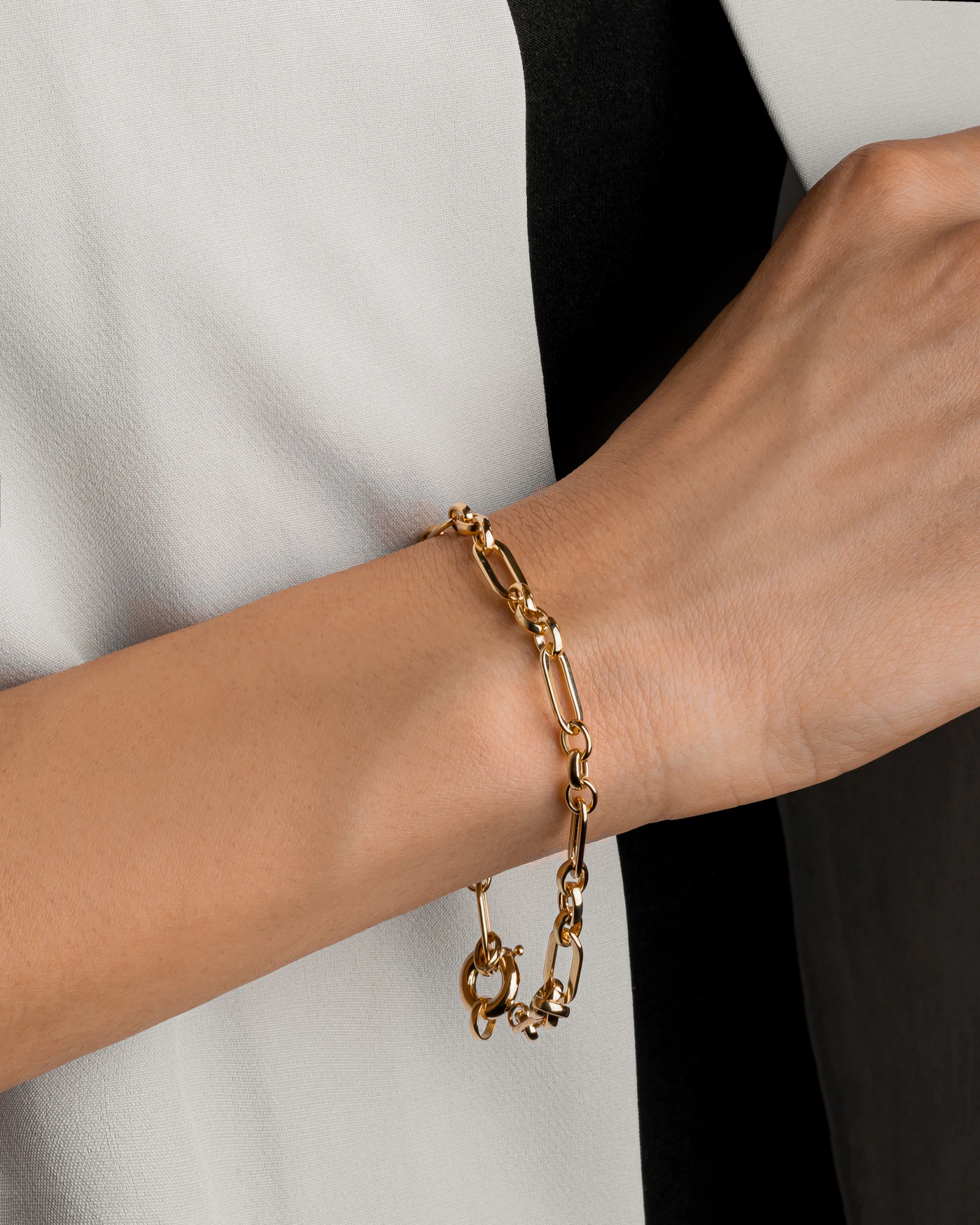
Three bracelets look effortless laid out on linen. On a wrist, they have to negotiate gravity, sleeves and one another. A good stack needs editing more than it needs another purchase. Begin with the bracelet you enjoy wearing most, then build around the space and movement it leaves.
Treat the first arrangement as something to try with pieces already in your drawer. A chain, a bangle and a colourful cord can reveal your preferences even if they are not the final combination. The experiment should identify a useful gap, not create a shopping list of compulsory layers.
Choose one anchor
The anchor is the piece your eye notices first: perhaps a wider chain, a simple cuff or a bracelet with a distinctive charm. Put it on alone and decide where it naturally settles. Every additional piece should have enough space to be seen without pushing that anchor into an awkward position.
If all your bracelets are similarly delicate, one can still lead through colour or texture. An anchor does not have to be expensive or oversized. It simply gives you a reference for deciding whether another bracelet adds something useful or makes the composition harder to read.
Add contrast with restraint
Try one change at a time. Put a smooth bracelet beside a linked one, or a narrow shape beside a wider one. Stand back from the mirror after each addition. If you need a close photograph to appreciate the difference, ask whether that subtlety is what you want or whether the pieces are competing for the same role.
Colour can provide contrast without extra bulk. A small accent may connect with a scarf, bag or nail colour. Avoid treating every colour in the outfit as a matching assignment; repeating one is often enough. Remove the newest addition once and see whether the arrangement improves.
Check the space underneath
The underside of the wrist matters as much as the photographed top. Several clasps can gather in one spot, and overlapping extender tails can become more noticeable than the bracelets themselves. Turn your wrist over and see whether the fastenings sit comfortably when your hand rests on a table.
Different lengths may help separate the visible shapes, but adding length also increases movement. Follow each seller's size guidance and do not assume that buying everything loose will create a better stack. If a bracelet continually rides over your hand, it may need a different role in the arrangement.
Give the stack a real schedule
An arrangement for a short dinner can include movement or sound you would not choose for a working day. Keep those versions separate. You might wear the anchor and one chain in the morning, then add a bangle when changing for the evening. This makes the collection flexible without demanding that every piece work in every context.
If you wear a watch, consider dedicating the other wrist to the stack. Try a jacket and carry your usual bag during an indoor fitting. When the stack obstructs an ordinary motion, remove one piece before replacing everything with smaller versions.
Shop for the missing relationship
After several trials, you may discover that your collection needs one quieter spacer rather than another statement bracelet. Write down the useful width, adjustable range and visual role before browsing. Compare those notes with product measurements, since close-up photographs can make a narrow bracelet look substantial.
Also consider whether you will enjoy the new piece on its own. A bracelet with an independent role is easier to keep wearing when your preferred stack changes. Check care instructions for each material and avoid assuming that a mixed stack can share one cleaning method simply because it is worn together.
Find your best fit
| Consider | Best for | The tradeoff |
|---|---|---|
| Two-piece stack | A first experiment with clear shapes | Less variety, but easier movement. |
| Anchor with two fine layers | An outfit that benefits from more detail | Multiple clasps can gather beneath the wrist. |
| Bracelets across both wrists | Wearing several favourites with more space | The overall outfit may need simpler rings. |
A more considered purchase
- Start with one familiar anchor.
- Change one proportion or texture at a time.
- Look at clasps underneath the wrist.
- Remove a piece when movement feels crowded.
Explore the possibilities
Use the criteria above to compare individual pieces. These links lead to retailer collections, not a tested product shortlist. Check current materials, measurements, availability and return terms before ordering.
Astrid & Miyu
Explore the collection and review sizing, closures and individual care instructions.
Missoma
Browse current pieces and compare dimensions, finishes and styling options.
Your questions, considered
How many bracelets belong in a stack?+
There is no required number. Two can look complete, while a larger arrangement needs enough room and a reason for every addition.
Can all the bracelets be different metals?+
Yes. Keeping one shape or finish consistent can give a varied group a visual connection without making it match exactly.
The takeaway
A stack should feel like a useful way to wear your collection. Buy only after the trial reveals what is missing, and compare the linked shops for that specific role.