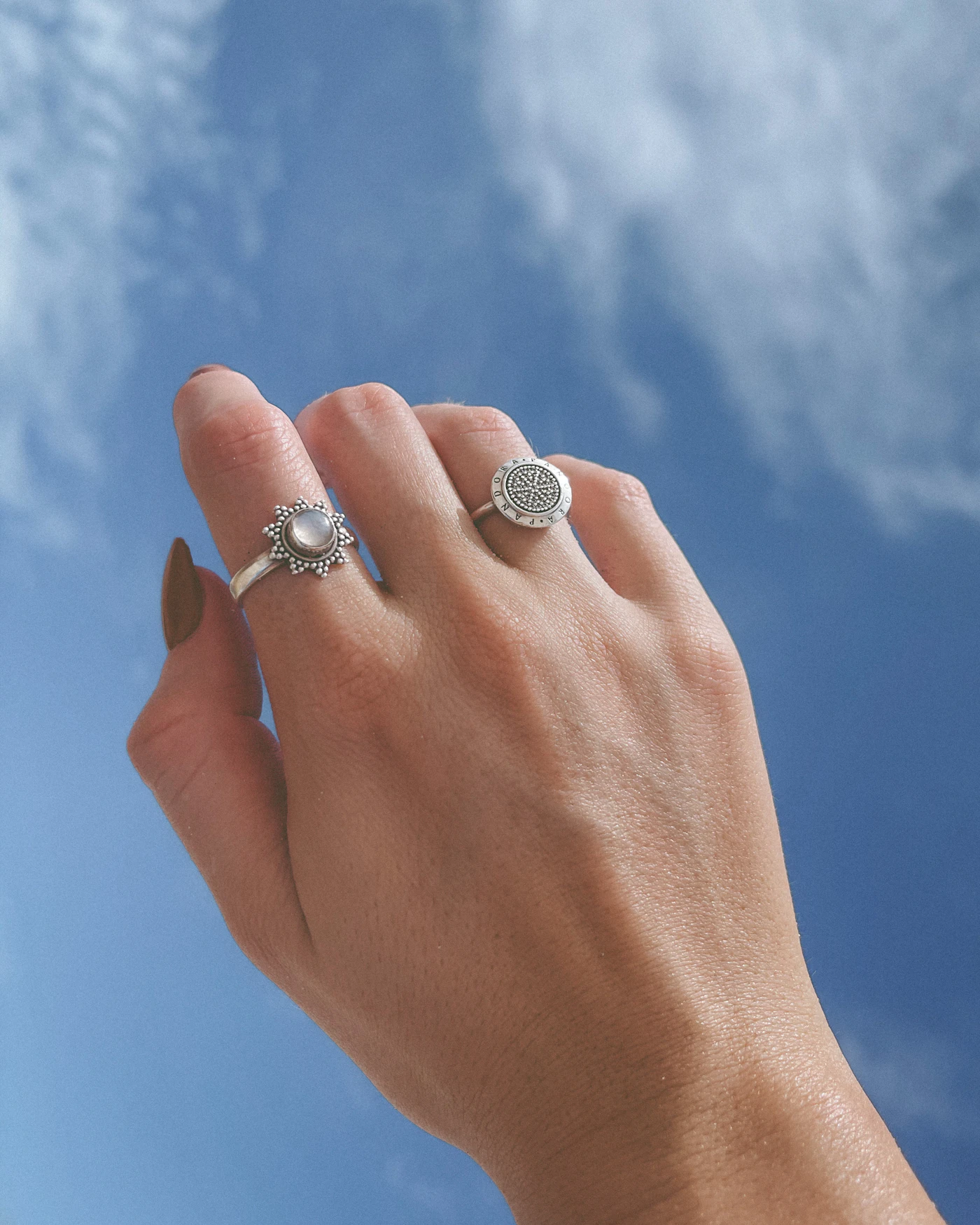
A ring stack looks beautifully balanced on a still hand. Then you pick up a coffee, type a message, or grip a bag handle and discover that the arrangement is less comfortable in motion. Rings are unusually close to the tasks of everyday life, so a useful stack has to work beyond the photograph.
Start with one ring you already enjoy wearing. Add slowly, test ordinary movements, and treat space as part of the design rather than something that must be filled.
Choose the ring that leads
Your anchor might be a meaningful band, a signet, or a ring with a distinctive stone. Put it on first and decide whether the next piece should sit beside it, on a different finger, or on the other hand. The strongest arrangement may distribute interest rather than concentrate everything in one stack.
An existing wedding or sentimental ring does not need to dictate every design choice, but its shape and position deserve consideration. Try supporting rings in a related finish or a simpler profile. If the anchor has a strong visual presence, quieter companions can help it remain clear.
Assess the combined width
Several slim bands create a broader area when worn together. A combination that looks delicate from above may still occupy considerable space along the finger. Do not assume that because each ring fits separately, the full stack will feel the same. Try the intended arrangement together or ask a jeweller for fitting help.
Pay attention to the spaces between fingers as well. Raised sides, broad shoulders, or textured edges can meet neighbouring rings when your hand relaxes. View the stack with your fingers resting naturally rather than spread apart for a photograph, then check whether any surfaces press in a way you dislike.
Use contrast with a clear purpose
A smooth band beside a textured one can make both easier to see. Different widths or metal colours can create a similarly useful distinction. Choose one or two contrasts rather than requiring every ring to introduce another idea. This keeps the arrangement legible and makes future additions easier to evaluate.
You can also repeat a shape across different fingers. A rounded signet and a curved band may feel connected without touching. If a stack feels crowded, move one ring instead of immediately buying a thinner replacement. The solution may be placement rather than another product.
Test the activities that matter to you
Hold your phone, type, pick up a pen, and put your hand into a pocket. If a ring catches or the stack presses uncomfortably, reconsider the arrangement. Activities involving tools, equipment, or workplace restrictions require their own safety rules; styling preferences come after those requirements.
Think about how often you will remove the rings and where they will go. A small designated container can make that routine easier. Avoid leaving loose rings on a shared counter or in a coat pocket. A stack is only practical if handling it fits the rest of your day.
Buy the next ring for a specific position
Describe the missing piece before browsing: a narrow smooth band beside a textured anchor, or a low-profile ring for the opposite hand. Check width, profile, available sizes, materials, and return terms. Product images may show combinations whose components are sold separately, so verify exactly what the listing includes.
Use the merchants below to compare candidates against your existing ring, not just against each other. If possible, try the intended combination before committing. Ask about resizing limits and compatibility where pieces touch, rather than assuming every ring can be adjusted or safely worn against every other design.
Find your best fit
| Consider | Best for | The tradeoff |
|---|---|---|
| Two contrasting bands | A simple stack with visible separation | Combined width changes the wearing experience |
| Anchor ring plus opposite-hand band | Interest with more physical space | A less concentrated stacked appearance |
| Several similar slim rings | A repeated rhythm | Can still crowd the finger when combined |
A more considered purchase
- Begin with one comfortable anchor.
- Assess the total width of the arrangement.
- Test with fingers resting naturally.
- Try normal hand movements before keeping a purchase.
Explore the possibilities
Use the criteria above to compare individual pieces. These links lead to retailer collections, not a tested product shortlist. Check current materials, measurements, availability and return terms before ordering.
Missoma
Browse current pieces and compare dimensions, finishes and styling options.
Mejuri
Explore the current jewellery collection and check material details on each listing.
Your questions, considered
Do stacked rings need to be the same size?+
Do not choose by that assumption. Fit depends on the individual ring, finger, and combined arrangement. Use the retailer's sizing process or a jeweller's fitting advice for the pieces you intend to wear together.
Can I mix metals in a ring stack?+
Visually, yes. Consider shape and finish alongside colour, and ask about practical compatibility when particular pieces will rub together. A pleasing colour combination does not remove the need to consider construction and comfort.
The takeaway
A good stack gives every ring a role and your hand enough room to move. Start with what already works, adjust the placement, and buy only the piece that improves the whole arrangement.